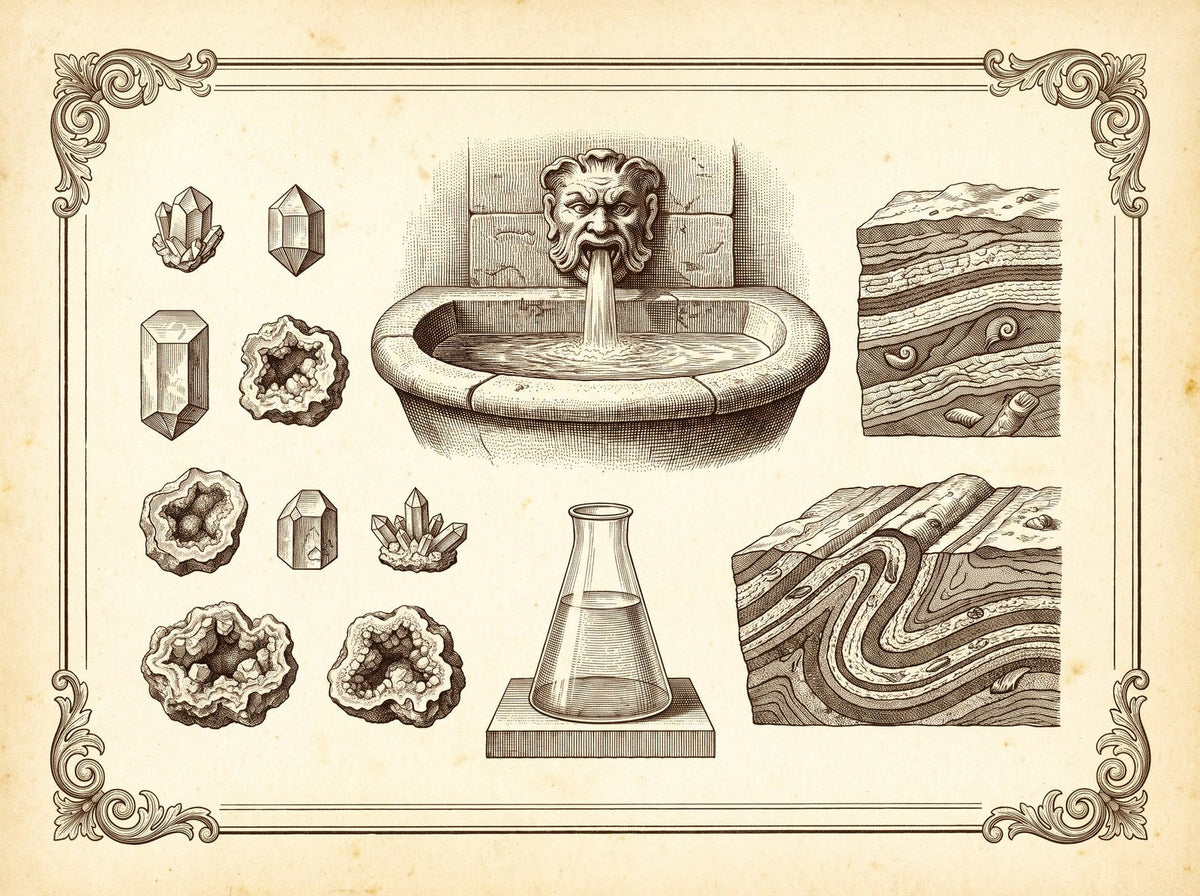
Winemakers have a word for the way a place imposes itself on what is made there: terroir. The same grape, grown on two hills, gives two wines. Laundry has a terroir too, and it flows out of your tap. The same garment, the same pearl, the same cycle will not smell quite identical in Phoenix and in Portland — and the difference is written in the water.
Hard water, soft water
As rain filters through rock, it collects minerals — chiefly calcium and magnesium. Water that has crossed limestone arrives "hard", heavy with them; water from granite country or surface reservoirs stays "soft". In the United States the divide is dramatic: much of the Southwest and Midwest washes in notably hard water, while most of New England and the Pacific Northwest enjoys soft.
Minerals are not neutral bystanders in a wash. Calcium binds to cleansing agents and neutralises part of them; it stiffens fibres, greys whites over time, and — what concerns a perfumer — it competes with fragrance molecules for a place in the fibre. Hard water is a crowded room in which a scent must raise its voice. Soft water is an empty salon.
What this means for your sillage
In soft-water cities, expect the full trail — the wardrobe effect arrives quickly and generously. In hard-water country, the scent is more discreet in the first cycles: polite, close to the cloth. It is not the pearl hesitating; it is the minerals talking over it.
Three courteous corrections
Give the ritual its month. Fragrance in fabric is cumulative; each cycle deposits a little more of the base notes into the fibre. Hard water slows the installation — it does not prevent it.
Use two pearls for large or heavy loads. Towels and bedlinen in hard water are the one case where the house recommends doubling: more cleansing agents to spend on the minerals, more essence left over for the cloth.
Air-dry when you can. High dryer heat evaporates precisely the molecules you paid for. A drying rack is the sommelier's choice.
The old washerwomen knew
It is no accident that the great historic laundries grew up beside soft rivers, or that Marseille — a city that made its fortune on soap — argued for centuries about its wells and aqueducts. Every laundress of the old world could tell you which fountain washed sweetest. The tap has replaced the fountain; the terroir remains.
Curious how your own water behaves? Ask the Nose on the front page — he has opinions about minerals.