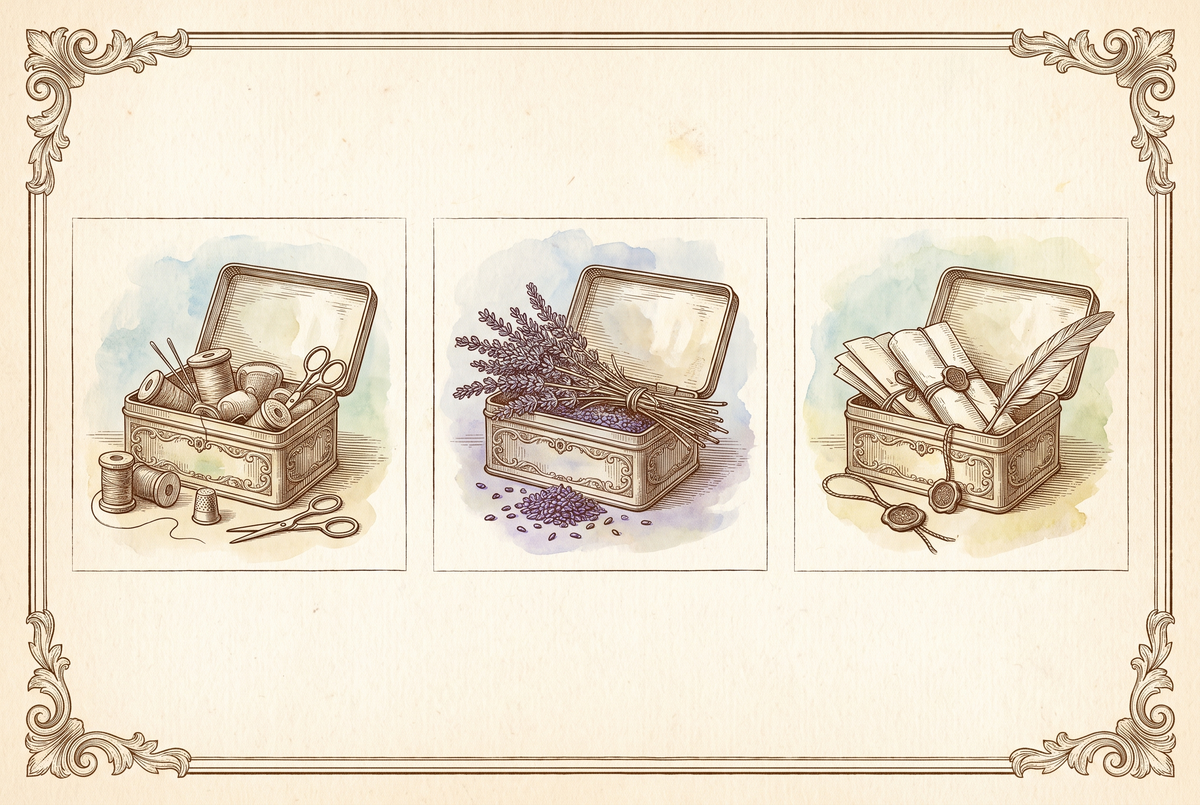
Every household of a certain age owns one: a tin — once biscuits, once tea — that has outlived its contents by decades and now holds buttons, or photographs, or the good scissors. Nobody decided to keep it. It simply refused, by quality, to become rubbish. There is a small theory of objects hiding in that refusal.
Packaging and possessions
Most containers are apologies — made to be discarded, designed accordingly. A possession is different: it is made as if it expected a future. Heavy tinplate, a lid that closes with a sound, ornament that costs real engraving — these are promises about time. The user hears them without being told, which is why the biscuit tin survives and the plastic tub does not. Beauty, it turns out, is a recycling programme that enforces itself.
Thirty cycles, then a second life
A Davyn tin holds thirty pearls — thirty washes, a season of linen. What it holds afterwards is the owner's affair, and the reports reaching the house are pleasingly varied: sewing kits, tea, love letters, the lavender of a summer garden, one collection of seashells. The tin was drawn for this: the baroque lid, the engravings, the four seals — none of it survives on a container meant to die. (Refills, in paper, carry the pearls thereafter; the arithmetic is set out on our sustainability page.)
The quiet economics
A beautiful permanent object is not an extravagance bolted onto a product; over years, it is the frugal option — one tin, many lives, no parade of disposable successors. Our grandmothers, who threw away almost nothing, understood this without a word for it. The house merely engraves the understanding in tin.